
Modern Quilts vs. Traditional Quilts: What's the Difference?
Quilting has been a beloved craft for centuries, but in recent decades a new movement has transformed the way makers think about design, color, and construction. The modern quilt has taken the quilting world by storm — appearing in galleries, design magazines, and on the beds of a whole new generation of crafters. But what exactly makes a quilt "modern," and how does it differ from the traditional quilts that have been passed down through generations? Let's break it down.
What Is a Traditional Quilt?
Traditional quilts are rooted in history, community, and time-honored patterns. Think Log Cabin, Wedding Ring, Nine Patch, Flying Geese, or Grandmother's Flower Garden — these are designs that have been handed down through families and quilting guilds for generations. Traditional quilts typically feature:
Symmetrical, repeating block patterns arranged in a predictable, balanced grid.
High-contrast or coordinated fabric collections, often florals, plaids, or reproductions of historic prints.
Precise piecing and careful attention to points and seams, with an emphasis on technical accuracy.
Dense, ornate quilting motifs such as feathers, cables, and crosshatching, often done by hand.
Traditional quilts are deeply tied to heritage. They tell a story through familiar forms and are prized for their craftsmanship and connection to the past. Many quilters today still love and celebrate traditional styles — and that's a beautiful thing. At QuiltStoryLabels.com, we know that every quilt, whether traditional or modern, carries a story worth preserving.
What Is a Modern Quilt?
The modern quilting movement emerged in the early 2000s, largely influenced by graphic design, minimalism, and the rise of the indie craft community. The Modern Quilt Guild, founded in 2009, helped define and organize this growing movement. Rather than following a strict rulebook, modern quilting is more of a design philosophy — but it does have some recognizable hallmarks.
Key Characteristics of a Modern Quilt
Modern quilts are defined more by aesthetic sensibility than by a specific pattern or technique. Common traits include:
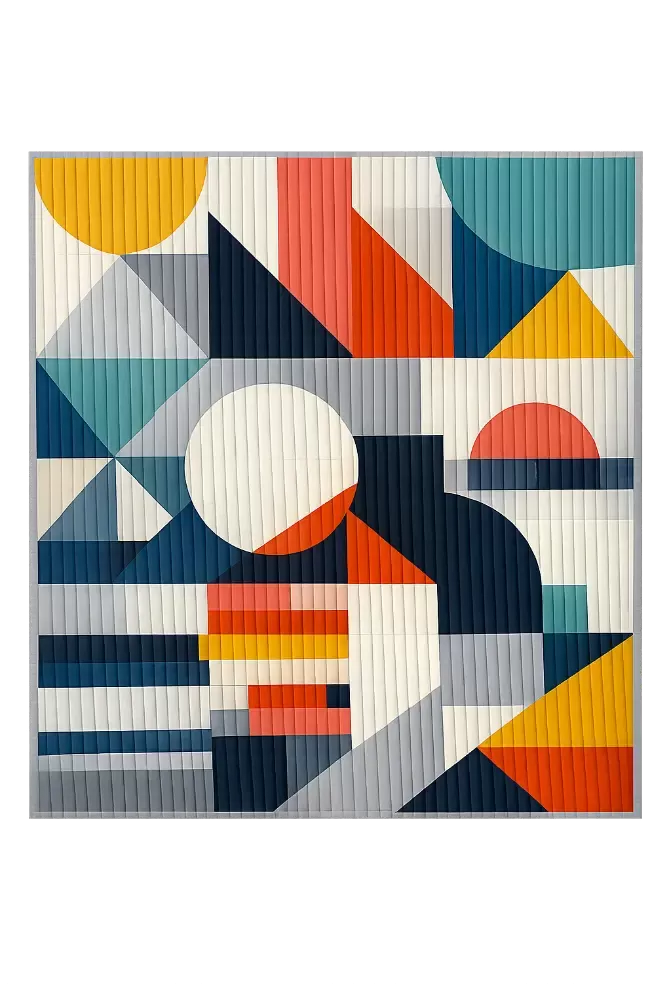
Bold use of negative space. Where traditional quilts fill every inch, modern quilts often let large expanses of solid fabric breathe, creating visual impact through restraint.
High-volume or low-volume backgrounds. Modern quilters love the interplay between busy, graphic prints and quiet, near-solid backgrounds.
Improvisational piecing. Many modern quilts are made without templates or rulers, embracing spontaneity and slight imperfection as a design feature.
Asymmetry and non-traditional layouts. Blocks may be off-center, scaled up dramatically, or scattered across the quilt top in unexpected ways.
Solid and shot-cotton fabrics. Modern quilters frequently gravitate toward solid colors or subtle textures rather than busy prints, letting the piecing design shine.
Straight-line or matchstick quilting. Rather than traditional ornate motifs, modern quilts are often finished with simple parallel lines or grid quilting, typically done on a longarm or domestic sewing machine.
Where Modern and Traditional Quilts Overlap
It's worth noting that modern quilting didn't abandon tradition — it reinterpreted it. Many modern quilts use classic blocks like the Half Square Triangle or Flying Geese but blow them up to giant scale, strip away the complexity, and pair them with unexpected solid colors. The result is something that nods to history while feeling completely fresh. This hybrid approach is sometimes called "modern traditional" or "mod-trad" quilting, and it's one of the most popular styles today.
Why Every Quilt — Modern or Traditional — Deserves a Label
Whether you're a devoted traditionalist or a boundary-pushing modern quilter, one thing remains the same: your quilt tells a story. A custom quilt label from QuiltStoryLabels.com ensures that story is never lost. Record the maker's name, the date, the inspiration, and the recipient — because decades from now, someone will want to know. Every stitch has a story. Make sure yours is told.